

“100 press-ups, 100 sit-ups, 100 kicks each leg!”
If you’ve ever trained in a traditional Muay Thai or kickboxing gym, there’s a good chance you’ve experienced something similar. The infamous “finisher” is an old-school method of ending a session with a brutal burst of conditioning, with the idea that pushing yourself to exhaustion will build a better fighter’s “gas tank.”
And although it feel great and gets the endorphins going, how effective is it actually?
The answer is a little more complicated than simply saying “it works” or “it doesn’t.” Kickboxing is a highly intermittent sport, requiring athletes to repeatedly produce high-intensity actions while also recovering between exchanges and rounds. This means a fighter needs a well-developed aerobic system, anaerobic glycolytic capacity and phosphagen (ATP-PCr) system. Research on kickboxing shows that both aerobic and anaerobic energy systems contribute significantly to performance, with the aerobic system playing an important role in sustaining repeated high-intensity actions and facilitating recovery between efforts.
The problem with the traditional finisher is specificity. Completing 100 press-ups or 100 sit-ups might create a huge amount of local muscular fatigue, but that doesn't automatically mean you have provided the optimal stimulus for improving the physiological qualities that determine a fighter’s conditioning.
Modern strength and conditioning methodology would instead look at what energy system we are trying to train and what intensity, duration and work-to-rest ratio are required to target it. A typical 60–90 minute kickboxing class can certainly contribute to a fighter’s aerobic development, particularly through continuous technical work, pad work, drilling and sparring. However, simply being tired at the end of a session does not mean you have maximally stimulated VO₂maxor developed your high-intensity anaerobic capacity.
For example, improving VO₂max generally requires periods of exercise performed at a sufficiently high intensity to place a substantial demand on oxygen uptake. High-intensity interval training (HIIT) has consistently been shown to improve aerobic performance and VO₂max, including in trained athletes.
Likewise, if the goal is to improve a fighter’s ability to repeatedly produce explosive efforts, we need to consider repeated-sprint ability, anaerobic glycolysis and phosphocreatine resynthesis, rather than simply accumulating as many repetitions as possible.
So the question isn't really “Are finishers good or bad?”
It's:
“What adaptation are we actually trying to create?”
If the goal is simply to make the athlete tired, almost any finisher will do.
If the goal is to make them better conditioned fighters, the training needs to be designed around the specific physiological demands of the sport.
So what do I do?
If I have slightly upset your understanding of what conditioning actually is, then fear not. Below is a list of different conditioning methods, when to use them, what they are designed to develop and the equipment you can use to get the job done.
The important thing to remember is that not all conditioning is the same. Different work durations, intensities and rest periods create different physiological demands. Rather than simply trying to make yourself as tired as possible, we want to choose the right method for the adaptation we are trying to develop.
The Dreaded Assault Bike!
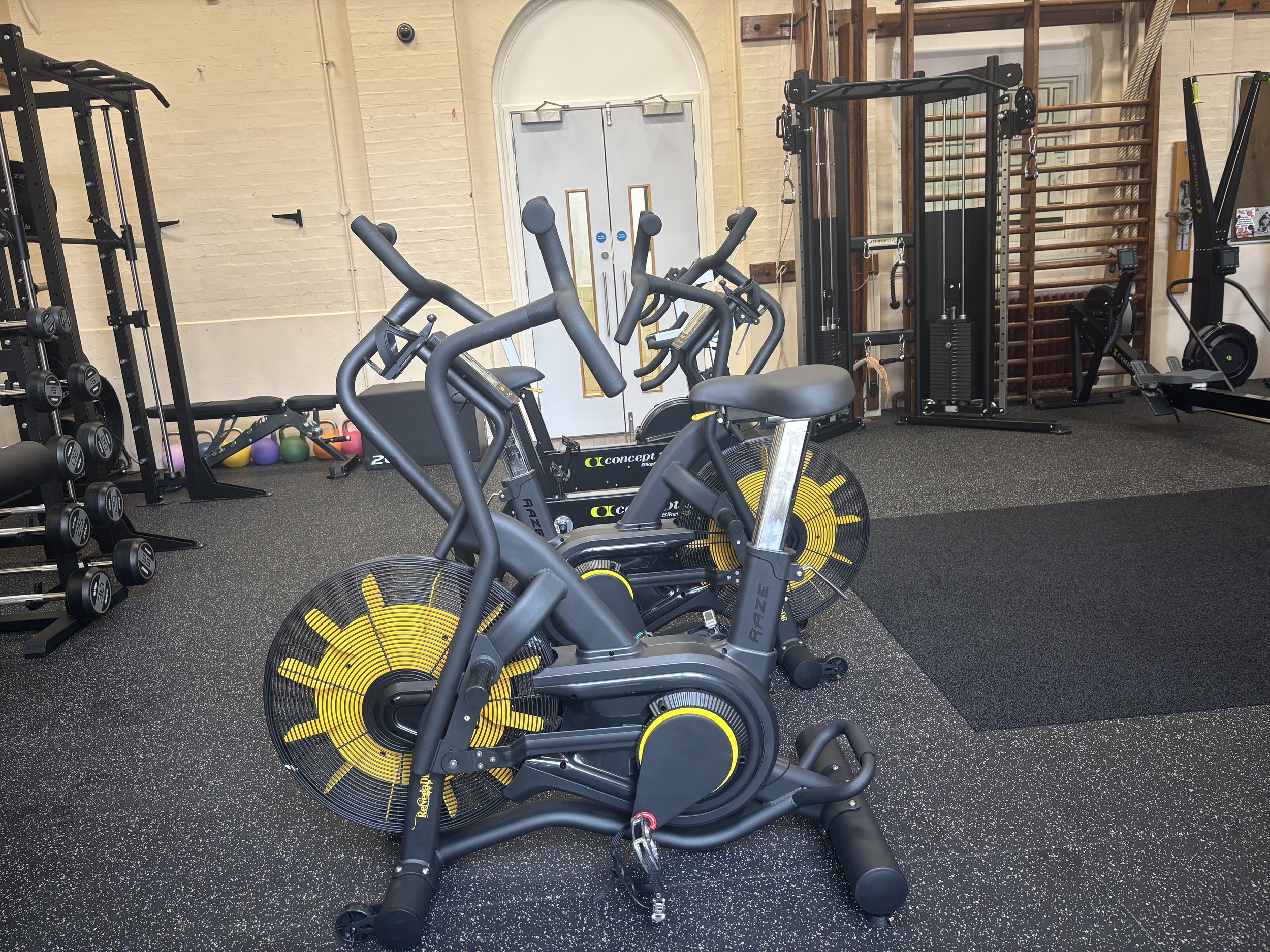
In our opinion, the assault bike is one of the best pieces of equipment for developing a fighter's conditioning. It is simple to use requiring relatively little technical skill and allows you to produce a very high cardiovascular stimulus without the impact in running.
This is particularly useful for fighters because conditioning sessions should complement technical training rather than unnecessarily adding fatigue, soreness or injury risk. The assault bike also uses both the upper and lower body, allowing you to produce a large amount of work while making it relatively easy to control intensity.
Don't have an assault bike? No problem. A stationary bike, rower or running can all be used effectively. The main consideration with running is that it is a higher-impact activity and requires a reasonable level of running competency. If running is not something you regularly do, it may be worth gradually introducing it rather than suddenly adding high-volume sprint work to an otherwise kickboxing-heavy training programme.
Ultimately, the assault bike gives us a big bang for our buck: low skill requirement, full-body involvement, easy intensity control and the ability to create a large cardiovascular stimulus.
Outside of Camp
Build Your Base & Develop Your Aerobic Capacity
Outside of competition camp, the priority should be developing the aerobic system. This doesn't sound particularly exciting, but a well-developed aerobic system is incredibly important for a kickboxer.
Kickboxing isn't simply about producing one explosive effort. A fighter has to repeatedly attack, defend, move and recover throughout a round and then do it again in the next round. The aerobic system contributes to energy production during lower-intensity activity and, importantly, helps facilitate recovery between high-intensity efforts.
A stronger aerobic system can therefore help you recover between exchanges, recover between rounds and recover between training sessions. It also provides the foundation on which more intense conditioning work can be built.
Think of this phase as building the engine before asking it to repeatedly hit the accelerator.
Aerobic Threshold Intervals
4 minutes work : 2 minutes recovery (1:0.5 work-to-rest ratio)
Aerobic threshold intervals are designed to accumulate a relatively large amount of work at a controlled intensity. The aim isn't to sprint until you fall off the bike; it is to maintain a challenging but sustainable pace where you are placing a significant demand on the aerobic system without generating excessive metabolic fatigue.
These intervals are useful for increasing the amount of high-quality aerobic work you can tolerate while developing your ability to sustain a relatively high rate of aerobic energy production.
For a fighter, this provides a useful foundation for maintaining work output and recovering between harder effortswithout turning every conditioning session into another fight.
Aerobic Power Intervals
60–120 seconds work : 120–240 seconds recovery (1:2 work-to-rest ratio)
Aerobic power intervals move us further towards high-intensity work. The longer recovery period allows you to perform each interval at a much higher intensity than you could maintain during threshold training.
The objective is to spend repeated periods working at a high percentage of your aerobic capacity, creating a strong stimulus for improving VO₂max and high-end aerobic power.
For a kickboxer, this is particularly useful because it starts to bridge the gap between general aerobic conditioning and the high-intensity demands of fighting. You are still targeting the aerobic system, but you are asking it to produce energy at a much higher rate.
Early in Camp
As we move into camp, conditioning should gradually become more specific to the demands of competition. We don't necessarily need to abandon our aerobic work, but we can begin placing greater emphasis on the ability to repeatedly produce high-power efforts while maintaining quality.
Alactic Power Intervals
6–10 seconds work : 60–120 seconds recovery (approximately 1:10–1:12 work-to-rest ratio)
Alactic power intervals are designed to maximise peak power output using the phosphagen, or ATP-PCr, energy system.
The short work period means the athlete can produce extremely high-intensity efforts without accumulating large amounts of metabolic fatigue. The long recovery period is deliberate; we want enough time for substantial phosphocreatine resynthesis so that each repetition can be performed at a very high quality.
This isn't conditioning designed to leave you gasping for air. In fact, if you finish the session completely destroyed, you've probably missed the point.
The goal is quality, not exhaustion.
For a fighter, this can help develop the ability to repeatedly produce explosive efforts such as powerful combinations, takedowns, throws, knees or explosive movements while maintaining a high level of power.
Late in Camp
High-Intensity Sprint Intervals
6–20 seconds work : 12–80 seconds recovery (approximately 1:2–1:4 work-to-rest ratio)
As competition approaches, conditioning can become increasingly specific to the demands of the fight. Short, high-intensity intervals with incomplete recovery allow us to repeatedly produce hard efforts while developing the ability to recover between them.
At this stage, the objective isn't simply to increase fitness for the sake of fitness. We want to prepare the athlete to repeat high-intensity actions, recover quickly and maintain output as fatigue accumulates.
The shorter intervals can be performed at very high intensity, while the reduced recovery increases the cardiovascular and glycolytic demand. This makes them useful for developing the repeated high-intensity effort capacity that is important in kickboxing.
However, this is also where we need to be careful. More is not necessarily better. High-intensity conditioning creates a significant training load, particularly when combined with sparring, pad work, technical sessions and strength training. The closer we get to competition, the more important it becomes to balance the conditioning stimulus with recovery and the overall demands of the training week.
The goal of camp isn't to see how much punishment you can survive in training.
The goal is to arrive at competition in the best possible condition to perform.
Volume
Training volume is another extremely important factor to consider when developing conditioning. More training does not automatically mean better results. The right amount of volume will depend on the individual athlete, their training age, current fitness, competition schedule, technical workload and ability to recover.
This is particularly important in kickboxing because conditioning is only one part of the overall training programme. Fighters also need to develop their technical skills, tactical ability, strength, power and speed, while managing the fatigue created by sparring and competition.
Too little volume may not provide enough stimulus to create adaptation, while too much can lead to excessive fatigue, reduced performance and an increased risk of overtraining or injury. The goal is to find the minimum effective dose that produces the desired adaptation while still allowing the athlete to perform well in the rest of their training.
This is why conditioning should not be programmed in isolation. Your training volume should be planned around your individual needs and your competition calendar, ideally with the guidance of an experienced coach or strength and conditioning professional.
Are Traditional Methods useless?
No. They can have their place, and working hard will always be part of becoming a fighter. But simply finishing every session with 100 press-ups, 100 sit-ups and 100 kicks doesn't necessarily mean you're developing the conditioning qualities required to perform at your best.
Good conditioning is about understanding what you are training, why you are training it and when you should train it.
By manipulating intensity, duration, work-to-rest ratios, exercise selection and training volume, we can target different energy systems and physical qualities throughout the training year. More importantly, we can gradually move from general physical preparation towards the specific demands of competition.
At Sanda Kickboxing Academy, we understand that becoming an elite fighter requires more than simply working hard. Our coaches understand the demands of kickboxing and Sanda and can help you develop your fitness, strength, power, speed and technical ability through structured training.
Whether you're completely new to kickboxing or you're preparing to compete at the highest level, our goal is to give you the knowledge, coaching and training environment you need to reach your potential.
Don't just train hard. Train smart. Train with purpose. Become a better fighter.